
Beyond IQ: The Four Dimensions of Intelligence That Shape Our Lives
For generations, society has placed tremendous emphasis on intelligence. From school report cards to university entrance exams, we have been taught that academic excellence and intellectual ability are the primary indicators of future success. The concept of IQ, or Intelligence Quotient, has long dominated our understanding of what it means to be “smart.”
But as life teaches us, success is rarely determined by intellect alone.
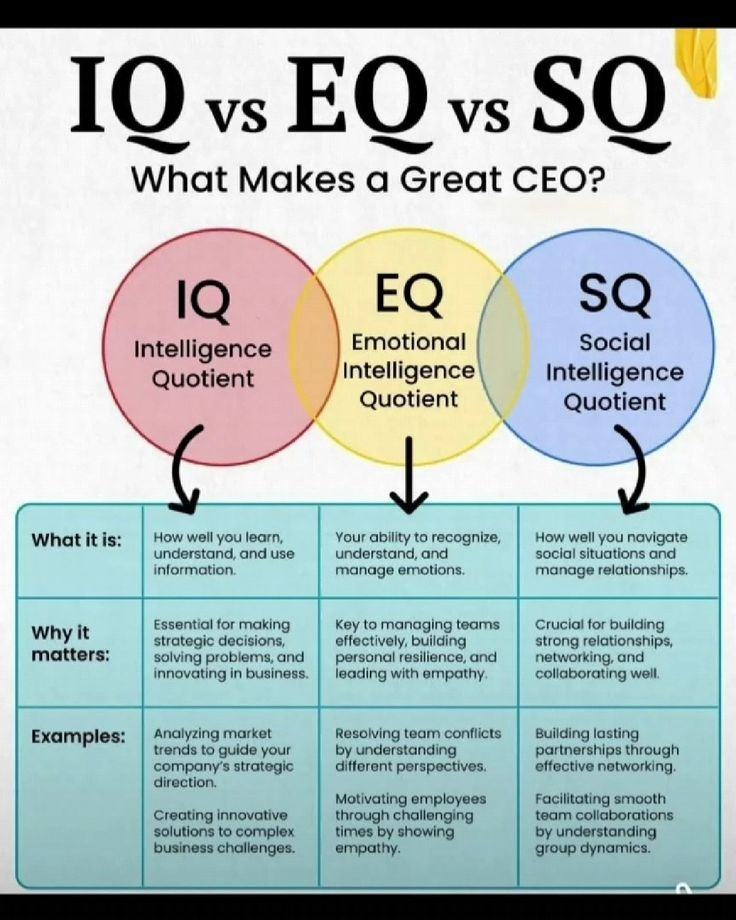
Many highly intelligent individuals struggle with relationships, workplace dynamics, and life’s inevitable challenges. Meanwhile, others with average academic abilities often excel because they possess qualities that cannot be measured by traditional intelligence tests. This realization has led psychologists, researchers, and personal development experts to explore broader dimensions of human capability.
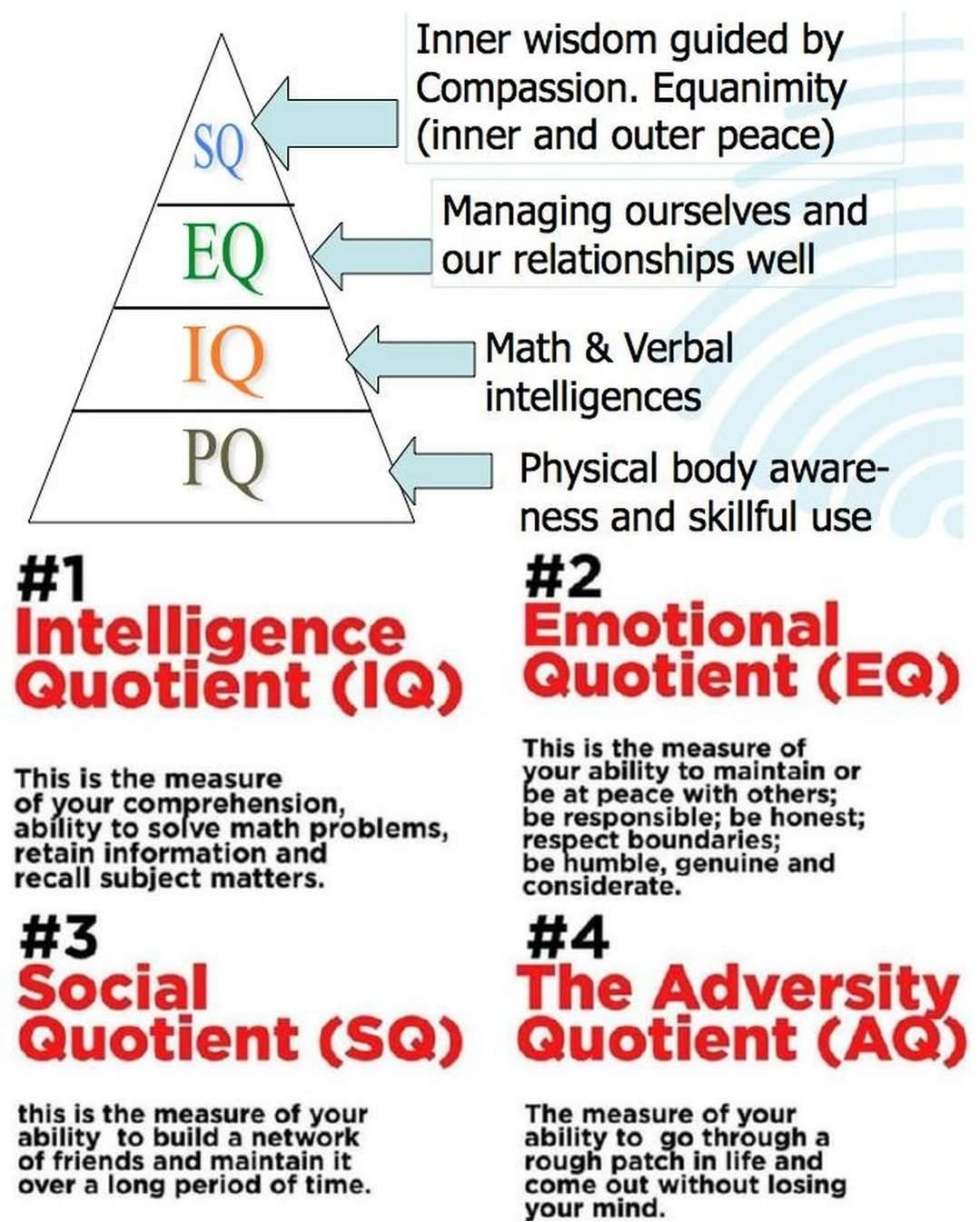
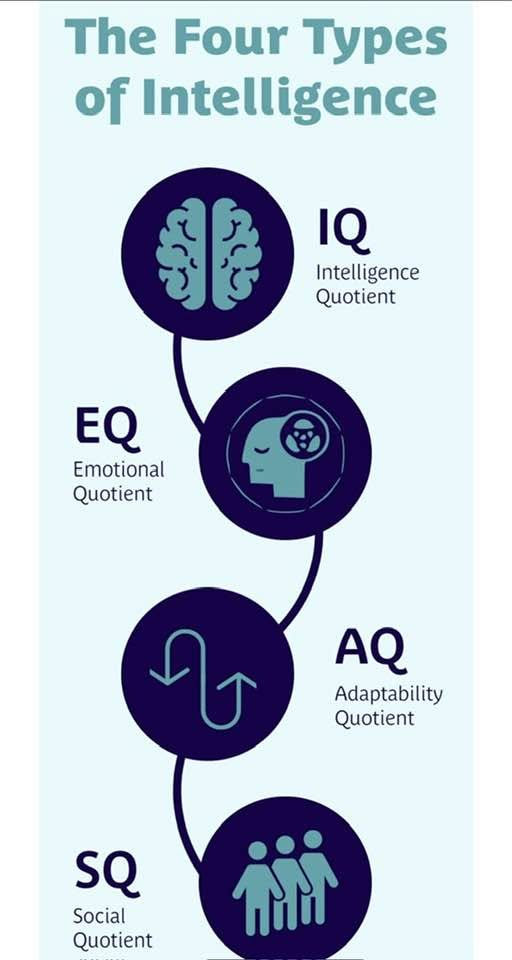
Four forms of intelligence are often discussed today: Intelligence Quotient (IQ), Emotional Quotient (EQ), Social Quotient (SQ), and Adversity Quotient (AQ). Together, they provide a more holistic understanding of what it takes to thrive in today’s world.
1. Intelligence Quotient (IQ) – The Ability to Think and Solve Problems
Example:
A university student consistently excels in mathematics, science, and analytical subjects. He can solve complex equations quickly, remembers information with ease, and graduates at the top of his class.
However, despite his academic brilliance, he struggles to work effectively in teams because he lacks interpersonal skills.
Lesson: IQ helps us acquire knowledge and solve problems, but it is only one aspect of intelligence.
2. Emotional Quotient (EQ) – The Ability to Understand and Manage Emotions
Example:
A manager receives harsh criticism from a client. Instead of reacting defensively or blaming her team, she remains calm, listens carefully, acknowledges the concerns, and works collaboratively toward a solution.
Her ability to manage emotions prevents conflict and earns respect from both the client and her employees.
Lesson: EQ allows us to respond rather than react.
3. Social Quotient (SQ) – The Ability to Build and Maintain Relationships
Example:
Two people apply for the same business opportunity. One has excellent qualifications, while the other has spent years nurturing genuine friendships and professional relationships.
When the opportunity arises, it is the second individual who receives recommendations and support because people trust and value the relationships he has built.
Lesson: Opportunities often travel through people.
4. Adversity Quotient (AQ) – The Ability to Overcome Challenges
Example:
A small business owner loses nearly everything during an economic downturn. Instead of giving up, she learns new skills, adapts her business model, and slowly rebuilds her company.
Years later, she reflects on that difficult period as the very experience that taught her resilience and perseverance.
Lesson: AQ is not about avoiding hardship; it is about rising after being knocked down.
Why All Four Matter
Modern society often rewards IQ, but life requires much more than intellectual ability.
IQ helps us think.
EQ helps us understand.
SQ helps us connect.
AQ helps us endure.
Together, these four dimensions create a more complete picture of human potential. Success is rarely the result of one type of intelligence alone. It is the combination of knowledge, emotional maturity, social skills, and resilience that enables individuals to flourish in their careers, relationships, and personal lives.
A HISTORICAL ILLUSTRATION
Many great leaders embodied all four quotients:
Abraham Lincoln demonstrated AQ through repeated political failures before becoming president.
Nelson Mandela displayed extraordinary EQ and AQ during and after 27 years of imprisonment.
Mahatma Gandhi showed remarkable SQ through his ability to unite millions behind a common cause.
Albert Einstein remains one of history’s most recognized examples of exceptional IQ
Perhaps the greatest mistake we make is assuming that intelligence is measured solely by academic achievement. Life continually reminds us that success is not determined by what we know alone, but by how we understand ourselves, connect with others, and persevere through adversity. A brilliant mind may open doors, but emotional wisdom, social awareness, and resilience are often what enable us to walk through them and keep moving forward when life becomes difficult.
In the end, the question is not “How intelligent am I?” but rather “Which intelligence do I need to develop next?” That answer may shape the course of our lives more than any test score ever could.