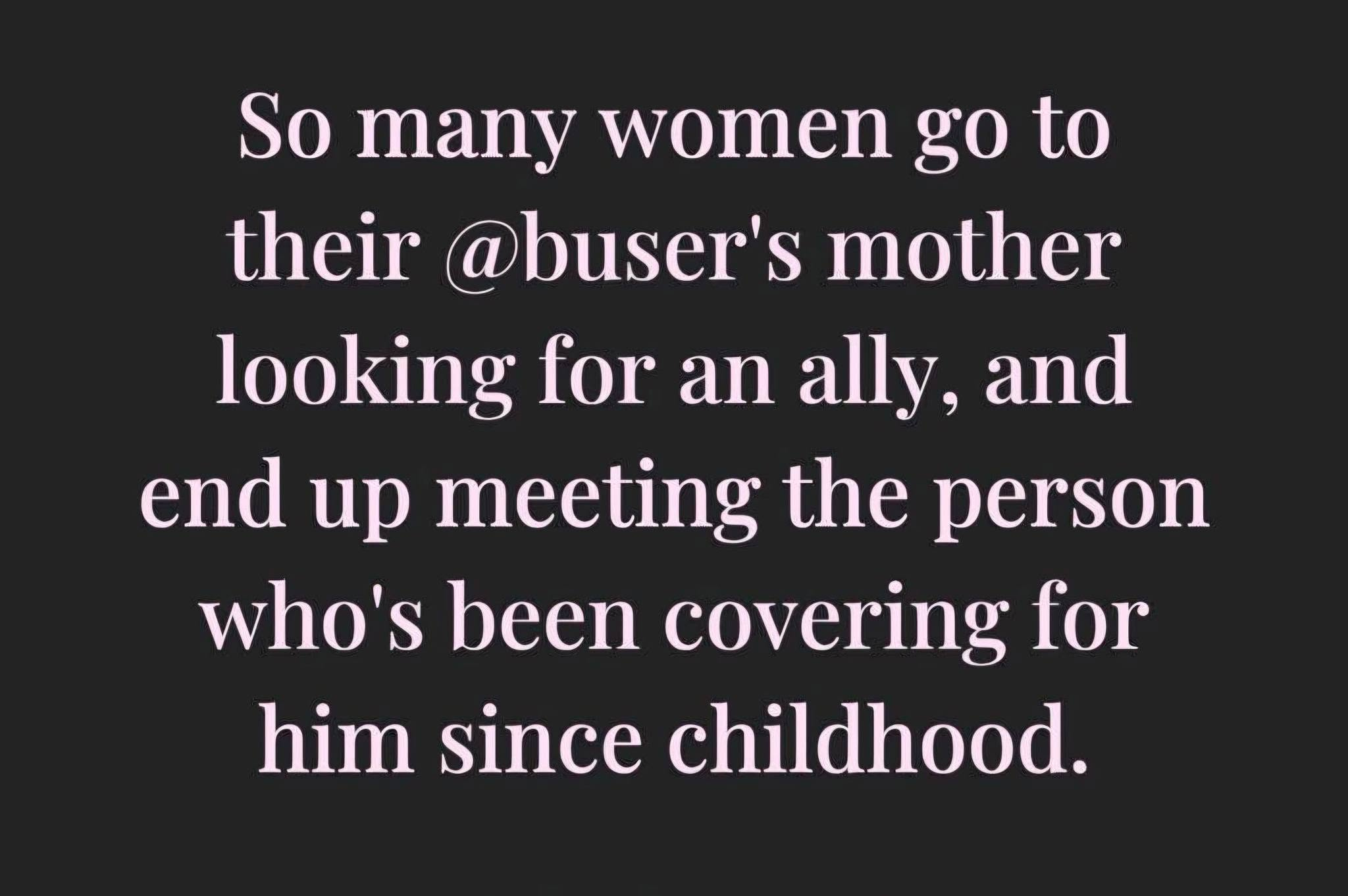
So many women turn to their abuser’s mother, hoping to find an ally, someone who might understand their pain, acknowledge the injustice, and perhaps help them make sense of the man they married.
But instead of finding an ally, they sometimes encounter the very woman who has been protecting him and making excuses for his behavior since childhood.
I know, because I lived through it.
Whenever I tried to make sense of his behavior, the response was often the same: “Oh, you know how he is!”
Just like that, his behavior was brushed aside, as though it were something I simply had to accept. There was always an excuse, always a reason why he should be understood, and seemingly very little consideration for the person who had to live with the consequences.
There is a Cantonese expression that captures this frustrating mindset rather vividly. Translated directly, it goes something like this:
“Even if the cloud falls upon him, he would think it was a blanket covering him!”
Can you imagine that? No matter what happens, no matter how unreasonable his behavior might be, there is always a way to interpret it in his favor. Even when the circumstances are staring everyone in the face, somehow, he can do no wrong! I had since realized that she was his enabler!
What a frustrating way to live when you are the one suffering, yet you are constantly expected to understand, tolerate, and make allowances for someone else’s bad behavior.
Those were truly frustrating years for me. I often felt that I was not only dealing with the man who hurt me, but also with a family dynamic in which his behavior had long been excused and normalized.
Looking back, I can understand that a mother’s relationship with her son can be complicated. Perhaps she had her own regrets, her own limitations, and her own reasons for avoiding difficult truths. Understanding those possibilities, however, does not erase the hurt caused by years of dismissal.
And yet, life sometimes gives us an unexpected moment of grace.
During the final years before her death, she apologized to me. She told me she was sorry because she had not known how to bring up her one daughter and four sons.
Her words stayed with me.
While her children were growing up, she was often away from home, playing mahjong with her friends, sometimes even through the night. Perhaps, in her own way, she had been avoiding the demands of motherhood. Perhaps she had not known how to guide her children or deal with their individual personalities and needs. I cannot know all the reasons, and I do not wish to pretend that I do.
But I appreciated that, in her later years, she was able to acknowledge her shortcomings and apologized.
That apology did not erase the years of hurt, nor could it undo the past. But it meant something to me that she was finally able to recognise that things had not been as they should have been.
Sometimes, we spend years waiting for someone to acknowledge what we have endured. Sometimes, that acknowledgement never comes. And sometimes, when we least expect it, it arrives in the form of a simple apology from someone we had almost given up hoping would understand.
I learned that forgiveness, understanding, and healing do not require us to deny our experiences. We can acknowledge another person’s limitations without excusing the harm they caused. We can accept an apology without pretending that the past never happened.
And perhaps the greatest lesson is this: we must never allow someone else’s refusal to acknowledge our pain to make us doubt the reality of our own experience.
We deserve to be heard. We deserve to be treated with dignity. And we deserve relationships in which compassion is not something we have to beg for.
If you have ever turned to a partner’s family for support, only to find yourself facing more excuses and more disappointment, know that you are not alone. Sometimes, the people we hope will protect us are simply not equipped to do so.
That is a painful truth to accept. But accepting it can also be the beginning of reclaiming our peace.
Finding My Own Peace
We may spend years hoping someone will finally understand our pain. We may long for someone to acknowledge what we have endured, to stand beside us, and to tell us that what we experienced was real. But our healing cannot depend entirely on another person’s ability or willingness to acknowledge it.
Sometimes, the peace we have been searching for must begin within ourselves.
Looking back, I realize that understanding another person’s shortcomings does not mean I have to excuse the hurt they caused. Nor does finding peace mean that the pain never mattered. It simply means that I no longer wish to let the past dictate the rest of my life.
My mother-in-law’s apology in her final years was something I came to appreciate. It could not undo what had happened, but it was an acknowledgement I had never expected to receive. I accepted it for what it was: a moment of recognition, however late it came.
Life has taught me that not everyone will understand our struggles, and not everyone will stand up for us when we need them most. Sometimes, the people we turn to for comfort may disappoint us. And sometimes, we must learn to stop looking for validation from those who cannot give it.
But we can still choose healing. We can choose dignity over resentment, acceptance over endless questioning, and peace over the exhausting need to make others understand.
Finding your peace does not mean your pain never mattered. It means your pain no longer gets to dictate the rest of your life.
If you are a woman who has felt unheard, unsupported, or alone in a difficult marriage or family relationship, please know that you are not alone. Your experiences matter. Your feelings matter. And you do not need someone else’s permission to begin healing.
May we all find the courage to release what we cannot change, the wisdom to establish boundaries where they are needed, and the grace to move forward without allowing yesterday’s wounds to rob us of tomorrow’s peace.
Because in the end, we may not always find the understanding we seek in others. But we can still find our way home to ourselves.